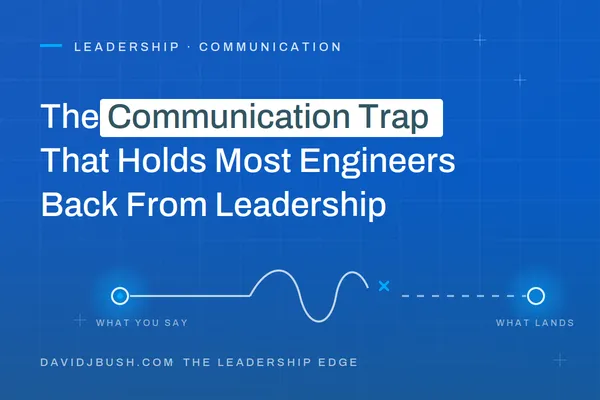
The Communication Trap That Holds Most Engineers Back From Leadership
Ask any senior engineer what they wish they had learned earlier in their career, and communication comes up more often than almost anything else. Not the technical kind - writing specifications, producing reports - but the human kind. The ability to make people listen, to influence decisions, to lead a room, to present a proposal and to be heard when it matters most.
For many technically trained people, this is a gap that goes unacknowledged for years. It only becomes visible — painfully visible — when you step into a leadership role and discover that your precision and depth, the qualities that made you excellent as an engineer, are now working against you.
Why Engineers Communicate Differently
Engineering trains you to communicate with precision. When you write a specification, every word matters. Ambiguity is dangerous. Detail is a virtue. You write for people who share your technical frame of reference and will read carefully.
Leadership communication operates on entirely different principles. Your audience often does not share your technical background. They are time-poor and attention-constrained. They are making decisions based on incomplete information. And they are frequently more interested in what something means for the business than in how it works.
When an engineer explains a problem in precise technical detail to a room of senior stakeholders, they often achieve the opposite of their intention. The detail signals complexity, breeds uncertainty, and dilutes confidence - rather than building it.
This is not a flaw in the engineer. It is a translation problem. The same information, framed differently for a different audience, lands completely differently. Learning to make that translation - fluently and quickly - is one of the most important communication skills a technical leader can develop.
Managing Up: What Your Seniors Actually Need to Hear
One of the most common communication failures I see in engineering leaders is the inability to communicate effectively upwards - to managers, directors, executives, and boards. This is not about simplifying your message. It is about reframing it.
Senior leaders and executives are managing risk, resource, and strategic direction. What they need from you is not a technical briefing — it is a clear statement of status, risk, and recommendation. What is happening? What does it mean? What do you need from them, if anything?
Engineers who learn to structure their upward communication around those three questions become dramatically more effective almost immediately. They get faster decisions, more support, and - critically - more trust from leadership.
Influence Without Authority
Technical leadership frequently requires you to influence people over whom you have no formal authority - contractors, partner organisations, client teams, regulatory bodies. This demands a different kind of communication: one built on credibility, relationship, and the ability to find shared interests.
Influence is not manipulation. It is the ability to help others see the situation clearly, understand what matters, and arrive at decisions that serve the shared goal. It requires listening as much as speaking - often more.
Many engineers find this uncomfortable, because it feels less rigorous than technical argument. But in most organisations, it is how things actually get done. The leaders who master it move faster, encounter less resistance, and build the kind of relationships that sustain a career over decades.
Communication as a System, Not a Skill
Effective leadership communication is not just about how you speak in meetings or write emails. It encompasses how you run conversations, how you give feedback, how you handle difficult exchanges, how you communicate in written form across different contexts, and how you adapt your approach to different cultures and personalities.
Each of these is learnable. None of them requires you to become a different person. They require deliberate attention and, usually, a willingness to recognise that the approach that served you well as a technical specialist is not always the one that will serve you best as a leader.
The engineers I have seen make the biggest strides in leadership are invariably the ones who treated communication as seriously as they would treat a new technical discipline — with curiosity, rigour, and a genuine commitment to getting better.
A Practical Starting Point
If you are serious about strengthening your communication as a leader, start by identifying the specific contexts where you feel least effective. Is it presenting to senior stakeholders? Giving difficult feedback? Running high-stakes conversations? Influencing across organisational boundaries?
Targeted development in specific areas is far more effective than generic communication training. And it starts with honest self-assessment.
My free scorecard. Are You the Leader Your Team Needs? Is the most direct way to identify where your leadership is strong and where it is holding you back. Two minutes of honest self-reflection can tell you more than months of generic development.
Take the Free Scorecard
Are You the Leader Your Team Needs? is a free, honest self-assessment for engineers moving into management, or who want to become more effective in the role they already hold. Rate yourself on ten core leadership qualities, spot your gaps, and walk away with a practical starting point for growth.
Take the assessment at: https://davidjbush.com/leadership-scorecard